
When we kicked off this muscle-building series we talked about how when volume is held equal rep ranges didn’t make a difference in terms of actual hypertrophy but that lower rep ranges led to greater strength gains. We talked a lot about the importance of volume when it comes to building muscle size and strength and I mentioned that while volume is important that doesn’t mean we can just run out and do crazy amounts of volume suddenly with no consequences. Today we will talk about ways to make sure you make continual progress assuring your body will never fully adapt to what you are doing.
 Enter Progressive Overload. As we discussed before total volume is sets x reps x weight. High volume has been shown to be great for maximizing hypertrophy. (1) But if you haven’t been using a high volume routine you can’t jump right into one immediately or you will surely burn out fast or worse, get injured. It must be done systematically and progress at a pace you can handle. This is where the term “progressive overload” comes into play. Progressive overload can be simply defined as how your body will not change unless it is forced to adapt to a tension above what it is currently used to.
This can be accomplished by many methods such as increasing the ever important volume, increasing frequency, exercises, intensity, altering rest periods and extending sets past what can be done on their own (think forced reps, drop sets, rest-pause, negatives, isometric holds, etc.) The simplest way would be to track your training volume and be sure you are doing more volume, but I wanted to show how there are many ways to use progressive overload and create additional tension and stress on your body to force it to adapt.
Unfortunately there is no simple math equation I can generically give out so you know just how to go about progressive overload, but I can give you some pointers. The first thing you need to keep in mind is progressive overload starts wherever you are currently at. Whether that be using mostly body weight or if you are squatting 400 lbs for reps. You must continually do more over time to keep progressing. If you always use the same weight for the same amount of sets and reps, your body will never change.
First thing’s first though, it all starts with what you can do with proper form. I would never want to add volume to a lift for someone who isn’t doing it right. That is just asking for an injury. It all starts with properly executing the movements. After that, how fast you jump up and which methods you use to increase your volume are highly variable and I couldn’t offer advice without working with you personally. If you are a beginner you will likely be able to make very large jumps fast because your body hasn’t adapted to your training stimulus yet. If you are more advanced the jumps will be slower and much less linear.
Speaking of the term linear, that brings up another point. Progressive overload, much like weight loss, will not always be linear. You will certainly have plenty of ups and down. The important thing is that over time you will go up, even though sometimes you may have to go backwards to start moving forward again.
Heck just take my year and what that’s meant for me in this current phase of life.
[youtube https://www.youtube.com/watch?v=GtMDJibEJpA&w=560&h=315]
Obviously we can’t make increases every single week. If we could things would be much easier and everyone who made any effort would be in great shape, but you should certainly be striving to improve over time. Perhaps that’s every other week or every month or every micro or macro cycle. The important thing is to make sure you are using progressive overload for your muscles.
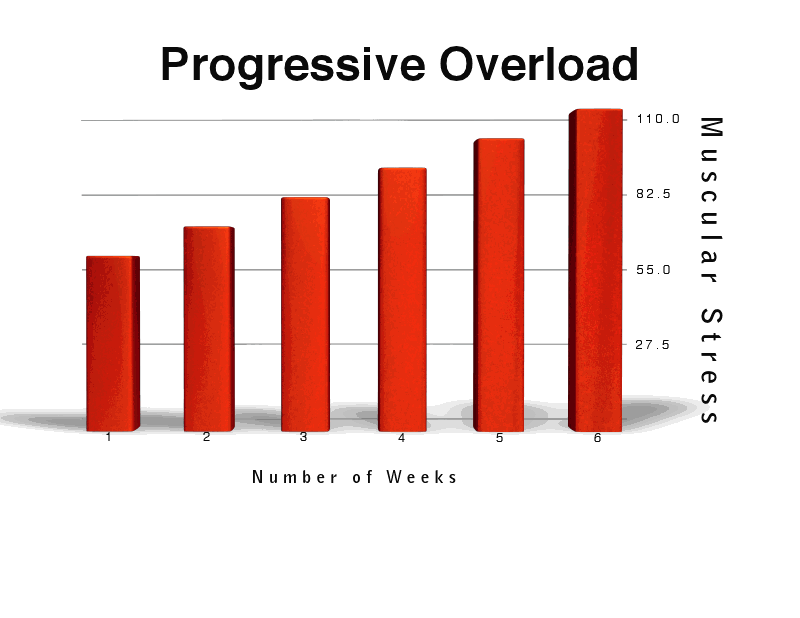 This is why I strongly recommend you keep a training log. Track which exercises you do and for how many sets and reps and at what weight and even add up that total volume so you can see just how much work you have done and what you should be striving to beat moving forward. Don’t forget to alternate exercises from time to time as well. Current research suggests changes in exercises may be more effective than typical loading schemes for improving muscle strength (and as we discussed last week more strength = more volume and in turn more muscle in the long run.) (2) I personally suggest you change your assistance exercises every 4-6 weeks for intermediate to advanced lifters. Beginners can stay on a program longer and still make good progress.
To recap you want to make sure your volume is increasing over time. While volume is great for muscle-building you can’t jump into a high volume routine from a low volume routine right away or you’ll risk injury or burn out. Over time by making appropriate changes you can get your volume up to ensure you are continually progressing. Remember, the body will not change unless you give it a reason to. As long as you are using progressive overload in any of its many forms then over time your body will improve.
For more information be sure to subscribe to my YouTube channel.